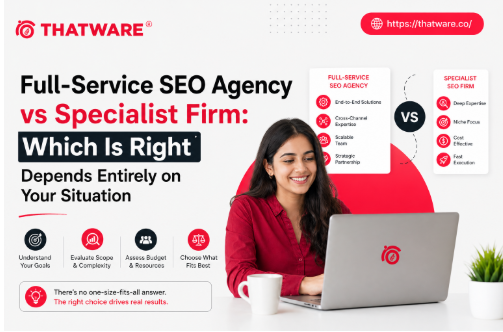
The SEO agency market offers two broadly different service models, and the choice between them matters more than most brands realize at the time they’re making it. Full-service agencies offer comprehensive coverage – strategy, content, technical, links, reporting – under one roof. Specialist firms go deep on a specific capability – technical SEO only, link building only, content SEO only – at the expense of breadth.
Both models have genuine strengths. Both have genuine limitations. And the right choice is almost entirely situational rather than universal.
What Full-Service SEO Agencies Actually Do Well
The core advantage of a full service seo agency is integration. When strategy, content, technical work, and link building are all done by teams that talk to each other – ideally daily – the outputs are more coherent. The content brief is informed by the technical constraints. The link building targets are shaped by the content strategy. The reporting synthesizes across all channels rather than producing siloed metrics that require manual integration by the client.
For brands that don’t have strong in-house SEO capability, this integration provides something genuinely valuable: a single point of accountability. When something isn’t working, there’s one team to work through it with rather than three different specialist agencies pointing at each other.
Where Full-Service Agencies Typically Fall Short
The weakness of the full-service model is that genuine depth is hard to maintain across multiple disciplines. End to end seo services that cover strategy, technical, content, and links comprehensively require specialists in each area working on your account – not generalists who can “do” each area at a competent but not expert level.
The reality in most full-service agencies is that one or two areas are genuine strengths and the others are adequate. The brand that needs exceptional technical SEO paired with a full-service agency whose technical team is merely competent is getting less than the situation demands.
When Specialist Firms Deliver More Value
Specialist firms make most sense in two situations. First, when a brand already has strong in-house SEO capability and is supplementing specific gaps rather than outsourcing the full program. A brand with a strong content and strategy team that needs a specialist link builder or a technical SEO expert to solve a specific problem gets better results from a specialist than from a full-service agency that adds overhead across areas already covered.
Second, when the specific area of need is genuinely advanced – technical migrations at enterprise scale, link building in a highly competitive regulated category, content programs at very high volume. The depth of specialist firms in their area of focus is generally higher than full-service firms in that same area, because specialist firms have no other areas pulling on their attention and resources.
The Hybrid Model That Many Brands Land On
A number of brands, after trying both models, land on a hybrid: a full-service firm handling strategy, coordination, and cross-channel reporting, with specialist firms or in-house specialists handling the execution of specific high-stakes areas. The full-service firm provides the integration; the specialists provide the depth.
This model requires more client-side coordination than pure full-service. The brand has to manage two or more relationships rather than one. For brands with the internal capacity to manage that coordination, the results typically justify the overhead.
The Decision Framework
The honest diagnostic: assess where your SEO capability gaps actually are, and whether you need breadth (full-service) or depth (specialist). If you don’t have internal SEO capability and need the program managed comprehensively – go full-service. If you have internal capability and specific gaps – go specialist for those gaps. If you’re at enterprise scale and the stakes are high in specific areas – go specialist for those areas and use a lighter coordinating layer for integration.
Neither model wins universally. The right choice depends on what you actually need.